

Homi
Your pocket companion for building connections and combating loneliness in a new country.
Generative Design Research
Business Strategy
Design Thinking Workshop
Prototyping
Usability Testing
PROJECT BACKGROUND
HOMI addresses the rising issue of loneliness among international undergraduate students adapting to life in a new country. This self-initiated project was developed as part of my academic journey in design innovation, combining UX research, design thinking, and user-centered methodologies.
SOLUTION
HOMI is a user-focused platform designed to help international students connect and navigate their new environment. It leverages research-driven insights and iterative design to deliver tools and resources tailored to their unique needs and challenges.
MY ROLE
I was the lead design researcher & strategist amongst a team of six and collaborated with international students and academic advisors. As the lead, I ensured seamless collaboration, stakeholder engagement, and maintained a user-first approach throughout the project.
-
Designed interview scripts, recruited 7 participants, and conducted hours of in-depth interviews to uncover key insights.
-
Synthesized findings into actionable insights, developed user personas, and mapped user journeys to define the problem space.
-
Facilitated team brainstorming sessions, created wireframes, and developed high-fidelity prototype.
-
Directed usability tests with 5 participants, driving design iterations to ensure alignment with user needs and goals.
DESIRED IMPACT
HOMI aims to reduce loneliness and foster a sense of belonging among international students, with a potential impact on over 200,000 undergraduate students annually. The project aspires to create a supportive community and improve their overall university experience.
DESIGN PROCESS
CONTEXT SETTING
The research began with a landscape analysis of Boston’s colleges, focusing on international student demographics, cultural diversity, and key institutions. This provided a clear understanding of the target audience and their context.
FIELD RESEARCH
The process began with focused group discussions, followed by 7 detailed interviews with international students from various countries to explore their experiences and challenges in the U.S.
ANALYSIS
Value Proposition Canvas (VPC) was populated by identifying jobs, pains and gains of international students.This analysis informed brainstorming of targeted products and services to alleviate loneliness.
PROTOTYPING
The prototyping stage turned ideas into solutions with low- and high-fidelity designs, showcasing event recommendations, communities, and safety tools.
USABILITY TESTING
Usability testing was conducted to evaluate personalized features of the prototype. Feedback from users helped identify areas for improvement, ensuring the design provided an intuitive effective experience.
PROBLEM SPACE
How might we address loneliness in international students?
loneliness
Boston, the third-most popular destination for international students in US, lacks tailored solutions to foster integration and community. Existing platforms like social media and dating apps fail to meet their unique needs, leaving students without effective tools to connect.
Barriers such as language anxiety, fear of judgment, and limited opportunities for structured social engagement contribute to disconnection, significantly impacting students' academic performance.
Social isolation
Lack of belonging
Challenges in building meaningful connections
Homesickness
Language barrier
TARGET USER PROFILE
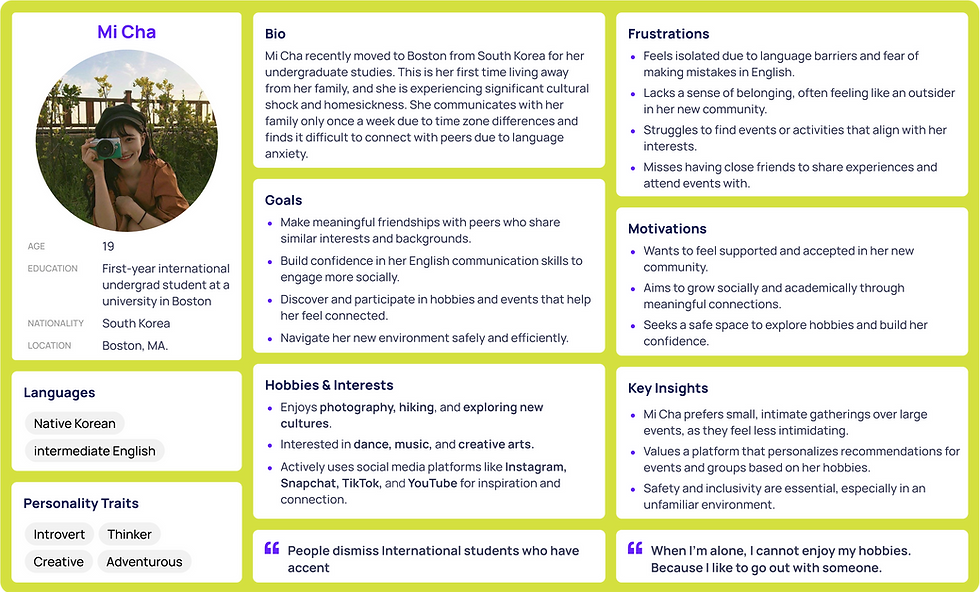
Through focus group discussions and in-depth interviews , the aim was to understand experiences and challenges faced by international undergraduate students in combating loneliness while adapting to life in Boston. Participants were students from diverse cultural backgrounds, studying at institutions like MassArt, Wentworth, Northeastern and Berkeley College of Music.
KEY FINDINGS
DESIRE FOR DEEP CONNECTION
Difficulty in forming meaningful friendships, particularly with peers who shared similar backgrounds or interests
These insights confirmed our hypothesis that loneliness among international students is rooted in a combination of cultural, linguistic, and social barriers.
LACK OF BELONGING
Feel excluded and struggled to integrate into local communities, leading to a sense of isolation
BARRIERS TO ENGAGEMENT
Want to engage in hobbies or attend events but lack companions and opportunities
LANGUAGE CHALLENGES
Fear of judgment and mistakes in English significantly reduce confidence and willingness to engage
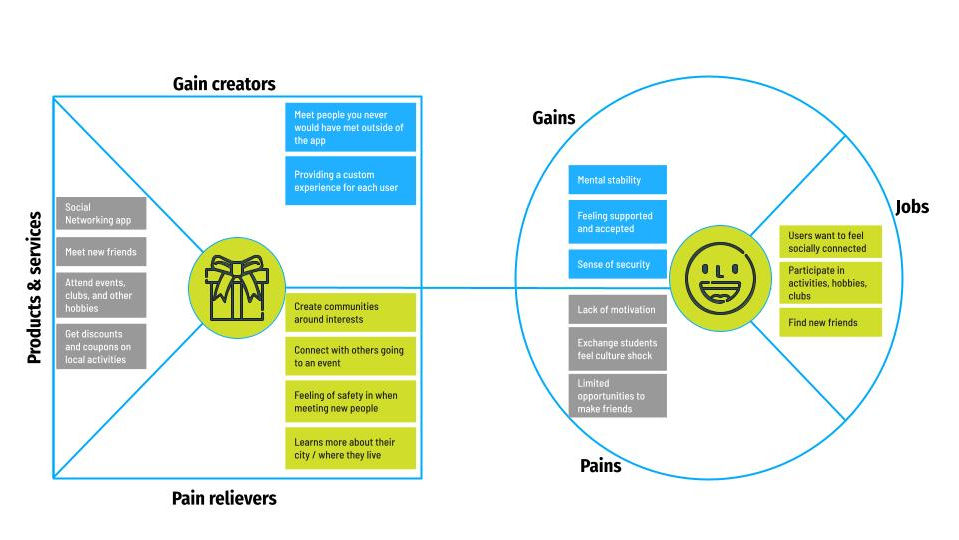
We used Value Proposition Canvas (VPC) to structure our ideation process, systematically analyzing the "Jobs to Be Done," "Pains," and "Gains" of international students. This framework highlighted unmet needs and aspirations, guiding the development of features to address challenges and enhance their social experiences.

For International college students in Boston
who are looking for community
Homi is a social network that curates a customized list of events, activities, and groups for each user and provides a safe space to find new friends.
Unlike existing social networks, our app encourages students to find and participate in communities of like minded people.
BUSINESS MODEL

Find like-minded people in a new country
01.
ONBOARDING
The onboarding feature guides users through setting up profiles, selecting interests, and personalizing preferences to create a tailored and engaging experience. Users will need college ID and email for onboarding in an app to ensure safety.
02.
HOMEPAGE
The home page serves as a personalized hub, displaying upcoming events, categorized favorite events, and updates on bookmarked activities. It also highlights events attended or marked by friends, offering users a tailored experience to stay connected and engaged with their community.
.png)
03.
EXPLORING COMMUNITIES
The events page provides a curated list of activities tailored to the user's interests, including categories such as hobbies, cultural events, and local meetups. Users can view event details, bookmark favorites, and see friends' activities, simplifying planning and connection.
04.
FIND EVENTS ON MAP AND TRACK FRIENDS ON MAP
This feature allows users to discover events in current location on a map and track friends’ locations in real-time, ensuring easy navigation and safety while attending activities.
05.
USER PROFILE
The user profile page showcases personal details, selected interests, and attended events. It allows users to manage preferences, view activity history, and connect with others via direct messages based on shared interests or common events.
DESIRED IMPACT
.png)
PERSONAL LEARNINGS
01.
Understanding where to stop
This project taught me the importance of striking a balance between feature richness and simplicity. As a designer, it’s tempting to keep adding functionalities, but I learned how critical it is to prioritize the user’s ability to navigate and use the app effortlessly. By focusing on the core features, we ensured the design stayed intuitive, impactful and familier.
02.
Recognizing emotional layers of design
Loneliness isn’t just a lack of connection; it’s a deeply emotional experience. This project showed me how vital it is to consider emotional nuances in design. Features like personalized event recommendations and friend-tracking weren’t just functional—they needed to feel supportive and safe, fostering a sense of trust and belonging.
03.
Behavior as insight
VA Red Coat
One of the most profound realizations was how much users’ unspoken actions revealed. Hesitations in interviews or repeated mentions of feeling “lost” reflected deeper issues, like a fear of judgment or discomfort in unfamiliar spaces. Observing and interpreting these behavioral cues informed the subtle yet critical design decisions.
Equity in Pulse Oximeter